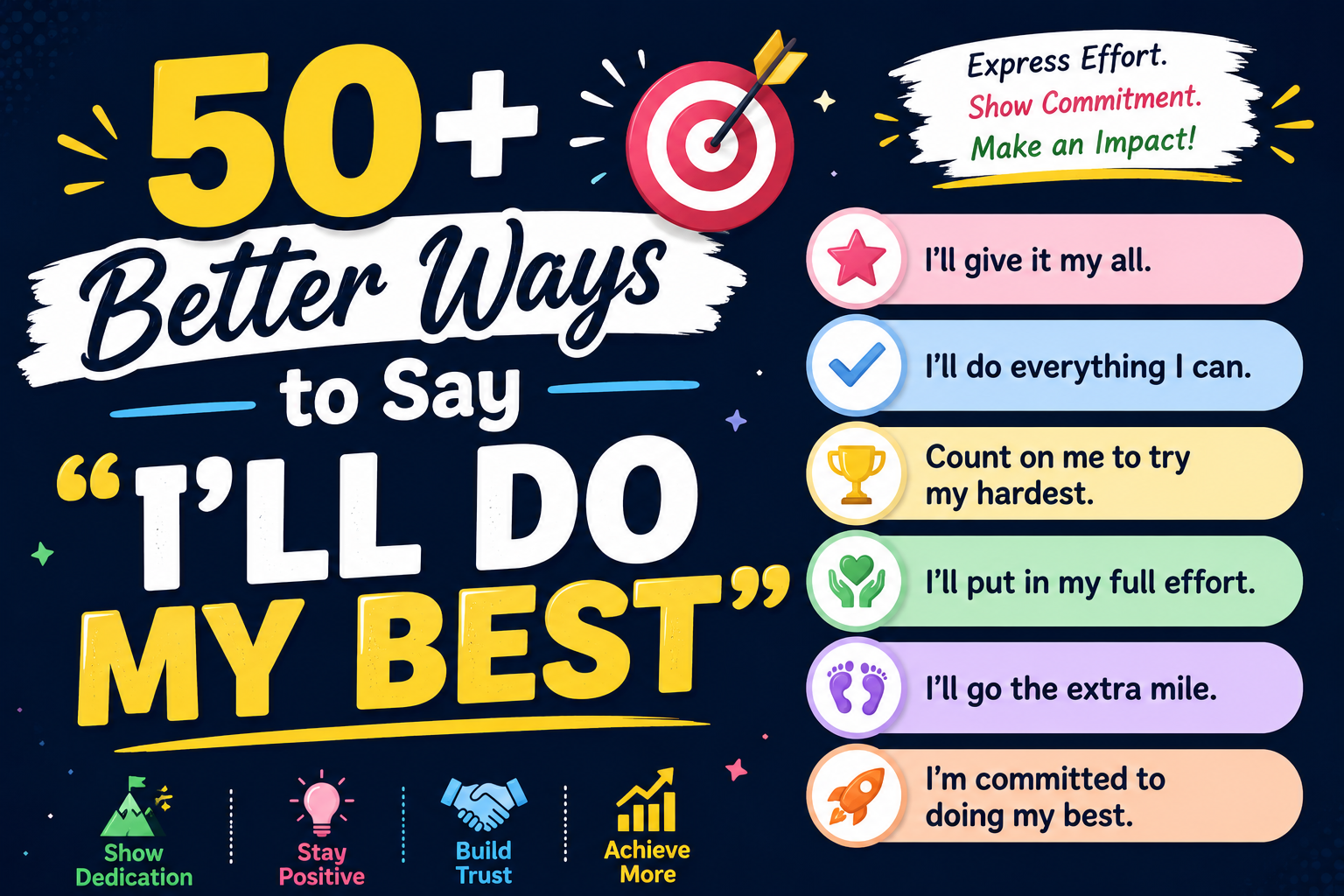
“I would do my best” sounds simple, but it can land very differently depending on context. In casual talk, it often comes across as sincere effort. In professional settings, it can sound vague—like you’re trying, but not fully committing check more here : 150+ Weekend Messages for My Love (Cute & Romantic)
This guide explains what the phrase really means, how “would” changes the message, and what to say instead when you want to sound confident, clear, and reliable—whether you’re replying to a manager, writing an email, or talking to someone close.
What does “I would do my best” really mean?
Literal meaning and intent
At its core, “I would do my best” means: If the situation happens (or if I’m given the chance), I will put in maximum effort. It’s an effort statement—focused on trying hard—rather than a guarantee of results. People often use it to sound responsible without promising an outcome they can’t fully control.
When “would” changes certainty vs “will”
The word “would” makes the sentence conditional and a bit less certain than “will.” It often implies:
- a hypothetical situation (“If you hired me, I would do my best.”)
- a polite, softer tone (“I would do my best to help.”)
- a response to uncertainty (“I can’t guarantee it, but I would do my best.”)
“I will do my best” usually sounds more direct and committed in the present or future.
Is it a promise or an effort statement?
Most of the time, it’s an effort statement, not a promise. It communicates willingness and intention, but it doesn’t clearly define:
- what actions you’ll take
- what “best” looks like
- when it will be done
- what success means
That’s why people sometimes ask for stronger wording or clearer next steps.
How listeners usually interpret it
Many listeners hear “I would do my best” as polite and cooperative, but depending on the setting, it can also sound like:
- “I’ll try, but I’m not sure.”
- “I don’t want to overpromise.”
- “I’m not confident I can deliver.”
If you want to avoid that ambiguity, pairing it with a specific action helps: “I would do my best—starting by doing X today.”
“I would do my best” vs “I will do my best”
Grammar difference (conditional vs definite)
- Would = conditional/hypothetical (depends on a condition or scenario)
- Will = definite future intention (more direct commitment)
So if you’re answering a real request or task, “will” usually fits better. If you’re speaking hypothetically (like in an interview), “would” can be natural.
Tone difference in spoken and written English
In conversation, “I would do my best” can sound polite and thoughtful. In writing—especially workplace emails—it may read cautious or uncertain unless you add specifics.
“I will do my best” sounds more immediate and action-ready, even if it’s still an effort-based phrase.
Which sounds more confident—and why
“I will do my best” generally sounds more confident because it removes the conditional layer. It signals: I’m taking this on.
“I would do my best” can still be confident when used correctly, but it often needs context to avoid sounding hesitant.
Examples showing the contrast in real sentences
- Interview/hypothetical: “If selected for the role, I would do my best to deliver strong results.”
- Real task/commitment: “I understand the priority. I will do my best to deliver by 3 PM.”
- Stronger alternative: “I understand the priority. I’ll deliver an update by 3 PM and share the next steps.”
“I will do my best” vs “I’ll try my best”
Why “try” can sound weaker
“Try” often signals uncertainty. People sometimes hear “I’ll try my best” as:
- “I might not do it.”
- “This isn’t a priority.”
- “I’m not confident.”
That doesn’t mean it’s always bad—it’s just easier to misinterpret, especially at work.
How “will” signals commitment
“I will” carries stronger intent and responsibility. Even though “I will do my best” still doesn’t guarantee results, it usually feels more committed than “I’ll try my best.”
When “try” is still acceptable
“Try” can be the right choice when:
- the outcome depends on others
- you genuinely don’t control the timeline
- you’re offering help, not owning the task
- you want to be careful not to promise too much
Example: “I’ll try my best to get a slot with them today, but their calendar is tight.”
Better replacements for both phrases
Instead of effort-only language, use action + clarity:
- “I’ll take this on and update you by [time].”
- “I’ll prioritize this and share progress today.”
- “I’ll do what I can and let you know what’s realistic by [time].”
- “I would strive to do my best, starting with [specific step].” (useful when you want a polished tone)
Why people say “I’ll do my best”
Politeness and humility
Many people use it to sound respectful—especially when replying to authority, a senior person, or a client.
Avoiding overpromising
It’s a safe phrase when you can’t fully control the outcome. You’re saying you’ll put in effort without guaranteeing perfection.
Uncertainty about outcomes
If someone’s unsure they can meet a goal, “I’ll do my best” can be a way to stay positive while staying honest.
Cultural and workplace habits
In some workplaces, “I’ll do my best” is a default polite response—especially where people value humility and avoiding strong promises.
When “I’ll do my best” works well
Casual conversations
It’s perfect for everyday talk:
- “Can you come tomorrow?” “I’ll do my best.”
- “Can you help me later?” “I’ll do my best.”
It also fits supportive situations with friends and family—like “I would do anything for my best friend” style conversations—where the point is sincerity, not a formal commitment.
Emotional or supportive situations
When someone is stressed, this phrase can feel caring:
- “I’ll do my best to be there for you.”
- “I’ll do my best to support you.”
When outcomes are outside your control
If results depend on approvals, schedules, or other people, effort language can be appropriate—especially when paired with a next step.
Early-stage commitments
If you’re still gathering info or planning, “I’ll do my best” can work as a temporary response—until you can confirm specifics.
When “I’ll do my best” sounds weak or risky
Professional settings (work, interviews)
In interviews or work updates, it can sound like you don’t have a plan. Stronger phrases build confidence.
Deadlines and responsibility-heavy tasks
When the expectation is delivery, “I’ll do my best” may feel uncertain. It’s better to communicate what you will do and by when.
Leadership and management roles
Leaders are often expected to give clear direction. “I’ll do my best” can feel vague if you’re responsible for outcomes.
Client or customer expectations
Clients want certainty and timelines. Effort-only language can reduce trust if it doesn’t include concrete next steps.
Professional alternatives to “I will do my best”
Confident workplace alternatives
- “I’ll get this done by [time].”
- “I’ll prioritize this and share an update by [time].”
- “I’ll take ownership and keep you posted.”
- “I’ll handle this and confirm the final details shortly.”
Email-friendly responses
- “Understood. I’ll proceed and update you by [time].”
- “Thanks for the direction—I’ll share progress today.”
- “I’m on it. I’ll send the first update by [time].”
- “I’ll review and return with recommendations by [time].”
Manager and leadership wording
- “I’ll align the team and send a plan within [timeframe].”
- “I’ll set priorities and share the next steps.”
- “I’ll address the risk and propose options by [time].”
- “I’ll ensure we’re on track and report progress.”
Client-safe phrases that show accountability
- “I’ll take care of this and confirm by [time].”
- “I’ll look into it immediately and follow up with an update.”
- “I’ll resolve this and keep you informed at each step.”
- “I’ll share a clear timeline after reviewing the details today.”
Polite alternatives to “I would do my best”
Respectful and humble options
- “I’ll do everything I can to support this.”
- “I’ll make every effort to deliver on time.”
- “I appreciate the opportunity—I’ll follow through.”
Soft but reliable phrasing
- “I’ll work on this and update you soon.”
- “I’ll start now and share progress by [time].”
- “I’ll take a careful approach and keep you posted.”
When you want to sound cooperative
- “Happy to help—what’s the priority?”
- “I can support. What would you like first?”
- “I’m available—share the deadline and requirements.”
Formal but warm expressions
- “I would be glad to assist and will proceed accordingly.”
- “I appreciate your trust. I will follow up with updates.”
- “I would strive to do my best and deliver a clear result.”
Strong and confident alternatives
Action-focused statements
- “I’ll start now.”
- “I’ll handle it.”
- “I’ll take the lead on this.”
- “I’ll complete the first step today.”
Outcome-oriented language
- “I’ll deliver the draft by [time].”
- “You’ll have an update by [time].”
- “I’ll confirm the final answer by [time].”
Ownership-driven responses
- “I own this.”
- “I’ll take responsibility for the outcome.”
- “I’ll coordinate with the team and close the loop.”
Phrases that build trust instantly
- “I’ll keep you updated at each milestone.”
- “If anything blocks this, I’ll flag it early.”
- “I’ll send progress by [time] and a final by [time].”
Casual alternatives for everyday conversation
Friendly spoken English options
- “I’ve got you.”
- “I’ll make it happen.”
- “I’ll see what I can do.”
- “I’ll do what I can.”
Text and chat responses
- “On it.”
- “Got it—doing it now.”
- “I’ll update you soon.”
- “Let me handle this.”
Supportive replies to requests
- “I’m here. Tell me what you need.”
- “I’ll help however I can.”
- “I’ll do my best to support you through this.”
Natural replacements that don’t sound stiff
- “I’ll take care of it.”
- “I’ll make time for it.”
- “I’ll figure it out and let you know.”
How to sound confident without overpromising
Acknowledge effort + state action
Instead of effort-only, combine intent with a concrete step:
- “I’ll do my best—starting with a draft today.”
Set realistic expectations clearly
If you can’t promise an outcome, promise a process:
- “I can’t guarantee approval today, but I’ll submit it by 2 PM and follow up.”
Combine commitment with clarity
- “I’ll handle this. If anything delays it, I’ll tell you immediately.”
- “I’ll aim for today and confirm by 5 PM.”
Examples of balanced responses
- “I’ll do my best to meet the deadline. I’ll send a progress update by noon.”
- “I’ll try my best to get it done today. If it slips, I’ll deliver it first thing tomorrow and keep you posted.”
How to choose the right phrase (quick guide)
If the task is fully in your control
Use clear ownership:
- “I’ll do it by [time].”
If the task depends on others
Use action + dependency clarity:
- “I’ll send it today and follow up for approval tomorrow.”
If you’re responding to authority
Show respect while staying clear:
- “Understood. I’ll proceed and update you by [time].”
If you’re leading or managing others
Use leadership language:
- “I’ll align the team and share the plan by [time].”
Common mistakes to avoid
Using vague effort-only language
“I’ll do my best” without a next step can feel unclear. Add a timeline or action.
Sounding unsure when certainty is needed
For deadlines and commitments, avoid language that sounds like a maybe.
Overusing “try” and “best”
Repeating “try” and “best” can dilute your credibility. Rotate in action-based alternatives.
Matching low-confidence language
If the situation needs clarity, don’t mirror uncertainty. Give a clear plan.
Copy-paste alternatives (quick list)
Best professional replacements
- “Understood. I’ll deliver by [time].”
- “I’ll prioritize this and update you today.”
- “I’ll proceed and share the next steps shortly.”
- “I’ll take ownership and keep you posted.”
Best polite replacements
- “I’ll make every effort to help.”
- “Happy to support—what’s the priority?”
- “I’ll handle what I can and update you.”
Best confident replacements
- “I’ve got this.”
- “I’ll take the lead.”
- “I’ll get it done.”
- “I’ll make it happen.”
Best casual replacements
- “On it.”
- “Got you.”
- “I’ll take care of it.”
- “I’ll see what I can do.”
Conclusion
“I would do my best” is grammatically correct and often sincere, but it’s most effective when you use it in the right context—or strengthen it with a clear action and timeline. If you want to sound more confident, swap effort-only wording for ownership-driven phrases like “I’ll handle it,” “I’ll deliver by [time],” or “I’ll prioritize this and update you today.” The goal isn’t to sound perfect—it’s to sound clear, dependable, and easy to trust.
FAQs
What does “I’ll do my best” mean?
“I’ll do my best” means the person is promising maximum effort. It’s a way of saying, “I will try as hard as I can,” even if the final result isn’t fully guaranteed. People often use it to show sincerity, responsibility, and willingness to help or deliver.
Is it correct to say “I will do my best”?
Yes, it’s correct and commonly used in both spoken and written English. “I will do my best” sounds direct and committed. It works well when someone asks you to handle a task, meet a deadline, or support them, especially if you add a clear next step (like a timeline or update).
What is the meaning of “I do my best”?
“I do my best” describes a general habit or consistent behavior. It means, “I always try to give my maximum effort.” It’s often used when talking about your attitude or work style, for example: “I do my best to meet deadlines” or “I do my best to be helpful.”
How do I reply to “I will do my best”?
A good reply should acknowledge their effort and (if needed) add clarity about expectations. Here are a few options:
- “Thank you—I appreciate that.”
- “Great, please keep me updated on your progress.”
- “Thanks. Let me know if you need anything to make it easier.”
- “Perfect—what timeline should we expect?”
- “Sounds good. I trust you—just keep me posted.”