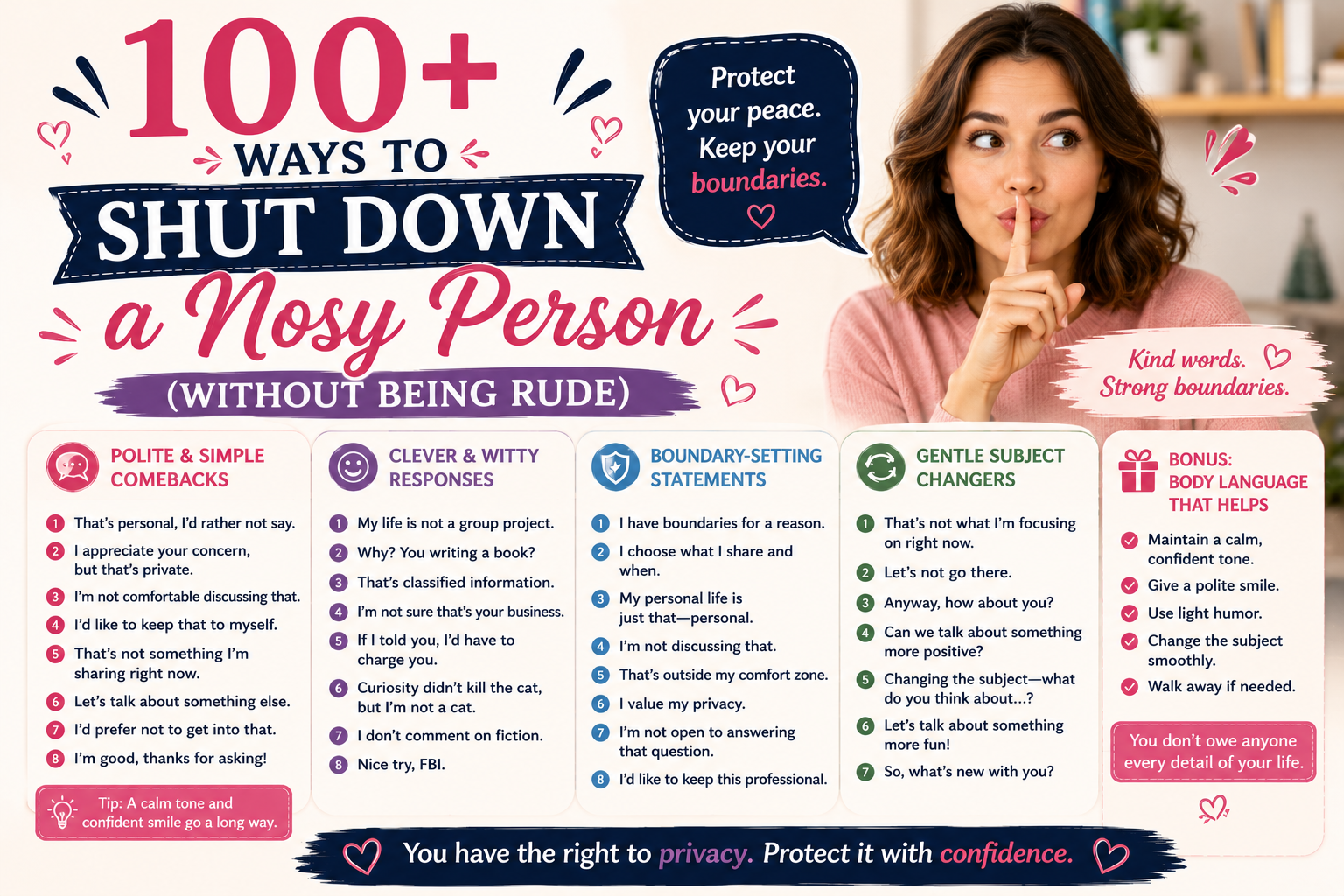
Nosy questions can feel harmless on the surface, but they often put you in an uncomfortable spot—especially when someone asks for details you didn’t offer. Knowing how to shut down a nosy person isn’t about being rude; it’s about protecting your privacy, keeping control of the conversation, and responding in a way that fits the situation. Whether it’s a coworker, a relative, or a stranger, the goal is the same: shut it down calmly, clearly, and without guilt check more here : 100+ Good Morning Message and Prayer for My Love
Why nosy people cross boundaries
Curiosity vs intrusion
Curiosity is normal: a friend asking a simple follow-up because they care. Intrusion is different: questions that pry into private areas or force you to explain yourself. A quick test is this: if you’d feel weird answering it in front of a room full of people, it’s probably intrusive.
Why some people feel entitled to personal info
Some people treat privacy like an invitation instead of a boundary. They might believe closeness equals access, or they assume they’re “just asking” so it must be okay. Others push because they’ve learned some people will eventually give in just to end the moment.
Why shutting it down early matters
If you answer a nosy question once, it teaches them that pressing works. Shutting it down early prevents follow-up questions, gossip loops, and repeated boundary testing. It also makes future conversations easier because your standard becomes clear. This is the heart of how to respectfully shut down a nosy persons inquiries—firm enough to stop it, calm enough to keep your dignity.
What makes a question nosy or intrusive?
Personal topics (money, relationships, body, plans)
Intrusive questions usually fall into “sensitive” categories:
- Money: salary, savings, debt, rent, purchases
- Relationships: dating status, breakups, marriage, kids
- Body/health: weight, pregnancy, medical issues, appearance
- Plans: timelines, life choices, “when are you going to…?”
Repeated questions after avoidance
A question becomes nosy when you’ve already dodged it and they try again:
- “Come on, just tell me.”
- “But why though?”
- “I’m only asking.”
Repeated pushing is a boundary problem, not a conversation.
Tone and context clues
Nosy questions often come with:
- a judgmental tone (“So why haven’t you…?”)
- a personal comparison (“I would never…”)
- an interrogation vibe (“Where were you? With who?”)
When “small talk” becomes invasive
Small talk stays light and optional. It becomes invasive when it demands personal disclosure, corners you, or keeps digging after you give a general answer.
Why people ask nosy questions
Lack of boundaries
Some people were never taught what’s appropriate. They may copy how their family talks or believe all topics are fair game.
Control or comparison
Nosy questions can be a way to measure themselves against you, check if you’re “ahead,” or get information they can use to steer opinions.
Gossip-seeking behavior
They want details to share, not to support you. If they ask many personal questions about many people, it’s a pattern.
Social awkwardness (not always malicious)
Sometimes it’s clumsy conversation. They don’t know what else to say, so they grab at personal topics. You can still set boundaries without assuming bad intent.
Best ways to shut down a nosy person
30 polite but firm responses
- “I’d rather not get into that.”
- “I keep that private, but thanks for understanding.”
- “I’m not comfortable sharing that.”
- “That’s personal for me.”
- “I’m keeping that to myself.”
- “I’d rather not discuss it right now.”
- “I’m not sure I want to talk about that.”
- “Let’s talk about something else.”
- “I appreciate you asking, but I’ll pass.”
- “I’m not sharing details, but I’m okay.”
- “I’ve got it handled, thank you.”
- “I’m keeping that between me and my family.”
- “I’m not ready to talk about it.”
- “That’s not something I share at work.”
- “I prefer to keep my personal life separate.”
- “That’s a private matter.”
- “I don’t really talk about that.”
- “I’ll let you know if I want to share.”
- “I’m not answering that, but I’m good.”
- “I’m not open to discussing that topic.”
- “Thanks for caring—no details though.”
- “I’m focusing on other things right now.”
- “I’m not comfortable going there.”
- “I’d rather not explain that.”
- “That’s not up for discussion.”
- “I’m keeping it simple: I’m fine.”
- “I’m going to keep that private.”
- “I don’t share that kind of info.”
- “I hear you, but I’m not discussing it.”
- “Let’s move on.”
25 witty or humorous deflections
- “If I told you, I’d have to write a whole book.”
- “That’s classified information.”
- “I’ll answer that in season two.”
- “That’s above my pay grade to explain.”
- “Good question—next question.”
- “I’m practicing mystery today.”
- “Let’s pretend you didn’t ask that.”
- “I’m saving that story for my therapist.”
- “I’m not taking personal questions at this time.”
- “Wow, you went straight for the premium content.”
- “That’s a little too spicy for casual conversation.”
- “I’ll give you a vague answer: everything’s fine.”
- “I’m going to dodge that like a professional.”
- “Let’s keep life simple and not go there.”
- “I knew you’d ask that. I still won’t answer.”
- “My privacy called—it wants me to change the subject.”
- “I’m going to keep that one locked up.”
- “That’s a secret I’m taking to my grave… or at least today.”
- “Let’s talk about something fun instead.”
- “I’m not accepting intrusive questions right now.”
- “That’s between me and my future self.”
- “You’re curious—I respect it. I’m still not answering.”
- “That question comes with a subscription fee.”
- “Let me give you the short version: no comment.”
- “We’re not doing that today.”
20 confident and direct replies
- “I’m not sharing that.”
- “That’s private.”
- “I don’t discuss my personal life.”
- “Please don’t ask me that.”
- “That’s not your business.”
- “I’m not answering that question.”
- “I’m setting a boundary here.”
- “I’m not comfortable with this topic.”
- “Stop asking me that.”
- “I said I’m not discussing it.”
- “I’m not going into details.”
- “That’s off-limits for me.”
- “I’m not open to that conversation.”
- “I won’t be talking about that.”
- “I’m keeping that private—please respect it.”
- “I’m not having this conversation.”
- “That question is too personal.”
- “Let’s change the subject now.”
- “I’m ending this topic.”
- “That’s a boundary for me.”
15 short shutdown lines
- “No comment.”
- “I’d rather not.”
- “Not discussing that.”
- “That’s private.”
- “I’m good.”
- “Let’s move on.”
- “I’ll pass.”
- “Not my topic.”
- “I don’t share that.”
- “That’s personal.”
- “Not at work.”
- “Not today.”
- “I’m not answering.”
- “Different subject.”
- “We’re done with that.”
Polite ways to shut down nosy questions
Respectful boundary-setting
Use calm, direct language that doesn’t attack the person:
- “I keep that private.”
- “I’m not comfortable sharing.”
- “I’d rather not talk about that.”
Topic-change responses
Answer the emotion, not the question, then redirect:
- “I appreciate you checking in. Anyway, how have you been?”
- “All good on my end. What’s new with you?”
- “I’m focusing on other things—how’s work going?”
Neutral, calm phrases
Neutral lines are powerful because they don’t invite debate:
- “I don’t discuss that.”
- “I’m not sharing details.”
- “That’s not something I talk about.”
When politeness is enough
If they’re just being awkward or casually curious, a polite boundary plus redirect usually works. Save firm shutdowns for repeat offenders.
Witty and humorous shut-downs
Light jokes that deflect
- “If you’re writing my biography, I need royalties.”
- “That’s a ‘mind your business’ kind of topic.”
- “I’m keeping that one in my private folder.”
Clever redirections
- “Interesting question. Let’s talk about something more fun.”
- “I’ll trade you: you answer something awkward first.”
- “Before we go there—tell me what you’ve been up to.”
Humor that ends the topic
- “I’m allergic to that question.”
- “I’m not taking personal inquiries today.”
- “I’m going to skip that level.”
When humor works best
Humor works when the relationship is friendly and the setting is casual. If the person is pushy, humor can sometimes invite more pushing—switch to firm boundaries fast.
Confident and direct shut-downs (clear boundaries)
Saying “I don’t share that”
This is simple and hard to argue with:
- “I don’t share my salary.”
- “I don’t discuss my dating life.”
- “I don’t talk about my health.”
Calm but firm wording
Your tone matters more than the words:
- “I’m not discussing that.”
- “That’s private. Please drop it.”
- “I’m not comfortable. Let’s change the topic.”
Repeating your boundary
Repeat the same sentence, calmly:
- “Like I said, I’m not discussing it.”
- “I’m not answering that.”
- “I’m keeping it private.”
Ending the conversation
If they keep pushing:
- “I’m going to step away.”
- “We’re done with this conversation.”
- “I’m not continuing if you keep asking.”
Shut-downs by situation (what to say in real life)
At work or with coworkers
- “I keep my personal life separate from work.”
- “I’d rather not discuss that here.”
- “Let’s stay focused on the project.”
With family members
- “I know you care, but I’m not discussing it.”
- “I’ll share when I’m ready.”
- “Please stop asking—I need you to respect this.”
With friends
- “I’m not ready to talk about that.”
- “I’ll tell you when I want to, I promise.”
- “Let’s switch topics.”
With strangers
- “That’s personal.”
- “I’m not sharing that.”
- “Please don’t ask me that.”
In group settings
- “Not getting into that.”
- “Let’s keep it light.”
- “I’m not discussing personal stuff in a group.”
Shut-downs for specific nosy topics
Money and salary questions
- “I don’t talk about money like that.”
- “I keep finances private.”
- “I’m not sharing my salary.”
Dating, marriage, kids
- “I’ll share updates if and when I want to.”
- “That’s personal, but I’m good.”
- “I’m not discussing my relationship plans.”
Body, weight, appearance
- “I don’t discuss my body.”
- “That’s not an appropriate question.”
- “Let’s not comment on bodies.”
Personal plans or timelines
- “I’m taking things at my own pace.”
- “I’m not sharing my timeline.”
- “I’ll let you know if there’s news.”
Beliefs, politics, religion
- “I don’t debate that in social settings.”
- “I keep those views private.”
- “Let’s talk about something we can enjoy.”
Short responses that stop follow-up questions
One-line shutdowns
- “That’s private.”
- “I’d rather not.”
- “Not discussing that.”
- “Let’s move on.”
Non-answers that work
- “It’s handled.”
- “Everything’s fine.”
- “Long story.”
- “Nothing I want to get into.”
Using silence strategically
Pause, smile, and change the subject. Silence can communicate “not happening” without drama. If they push again, follow with one firm line: “I’m not discussing that.”
What to avoid when shutting someone down
Over-explaining
The more you explain, the more they ask. Keep it short and closed-ended.
Sarcasm that escalates conflict
Light humor is fine. Cutting sarcasm can turn a nosy question into a power struggle.
Apologizing for boundaries
You can be kind without being apologetic. “Sorry” can sound like you did something wrong.
Sharing “just enough” (which invites more)
Partial answers often trigger follow-ups. If you want privacy, don’t give “starter details.”
How to shut down a nosy person without guilt
Boundaries are not rude
Privacy is normal. Saying no to personal questions is basic self-respect, not disrespect.
You don’t owe explanations
A complete boundary can be one sentence. You’re not required to justify it.
Staying calm under pressure
Keep your voice steady, your words simple, and your face neutral. Calm confidence shuts down arguments.
Confidence vs aggression
Confidence is clear and controlled: “I’m not discussing that.”
Aggression attacks the person. Aim for firm, not hostile—especially if you’ll see them again.
Quick guide: choose the right shut-down in 5 seconds
Casual nosiness → polite deflection
“I’d rather not get into that. Anyway, how’s your week going?”
Repeated questions → firm boundary
“I’m not discussing it. Please stop asking.”
Workplace → professional response
“I keep personal topics private at work. Let’s stay on task.”
Disrespect → direct shutdown
“That’s not appropriate. I’m not answering.”
Conclusion
Learning how to shut down a nosy person is really learning how to protect your peace. Start polite when you can, get firm when you need to, and remember: you don’t owe anyone personal information. The best shutdown is short, calm, and consistent—especially if you’re dealing with someone who keeps pushing.
FAQs
How to deal with someone who is nosy?
Deal with nosy people by setting clear, calm boundaries. Start polite (“I keep that private”), redirect the topic, and stay consistent. If they keep pushing, move to firmer language and limit what you share. You don’t need to explain or justify your privacy.
How to outsmart nosy people?
You outsmart nosy people by not giving them usable information. Use brief non-answers, change the subject, or respond with humor that ends the topic. The key is consistency—once they realize pushing doesn’t work, they usually stop.
How to politely tell someone to stop being nosey?
Use respectful, direct language:
- “I’m not comfortable sharing that.”
- “I’d rather keep that private.”
- “Let’s talk about something else.”
Polite doesn’t mean vague—clear boundaries are easier to respect.
How to defeat nosy questions?
Defeat nosy questions by keeping replies short and closed-ended. Avoid over-explaining, don’t apologize for boundaries, and repeat the same calm response if needed. If the situation calls for it, silence or changing the subject can be just as effective.