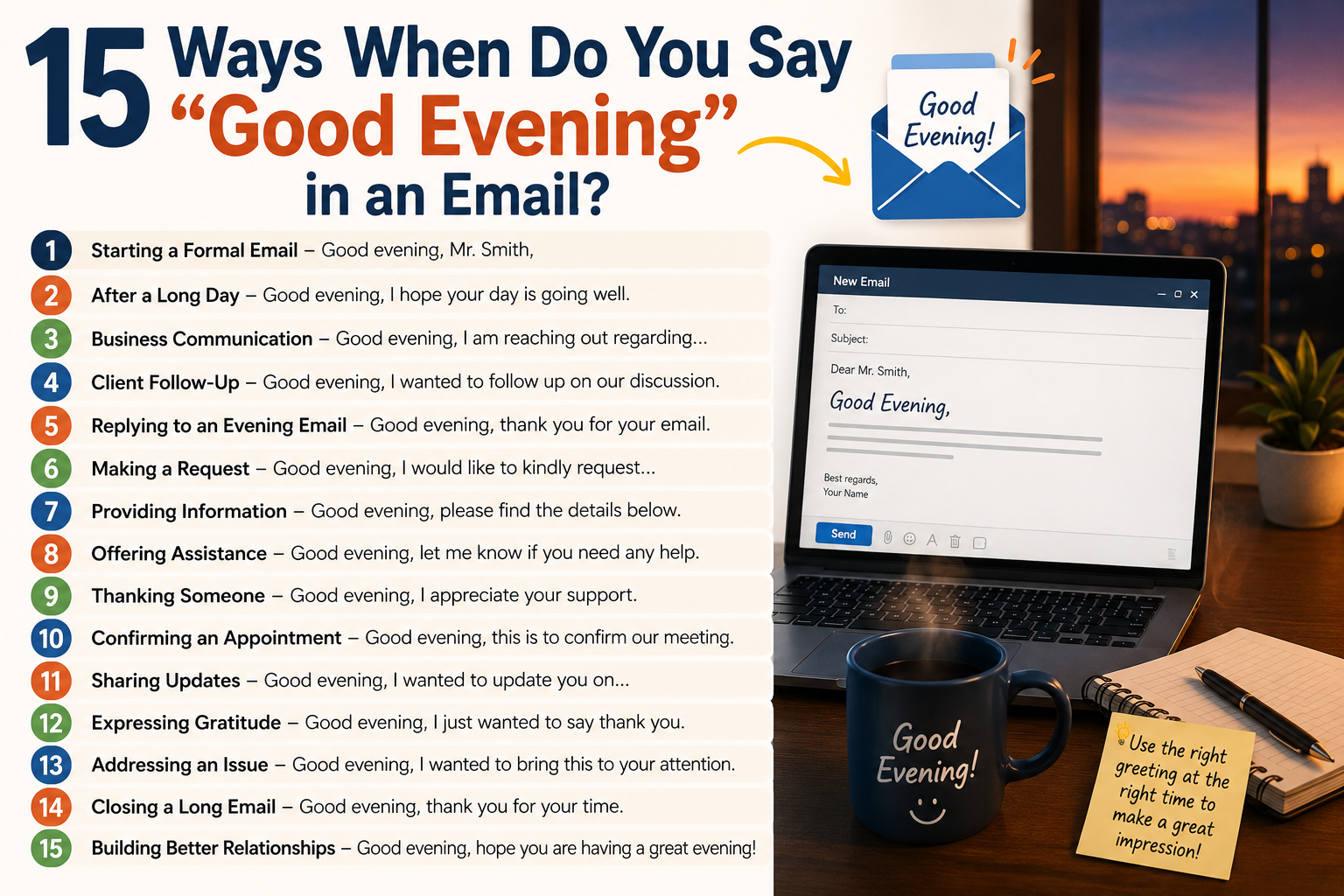
Sending an email at the wrong time-based greeting can make an otherwise professional message feel slightly off. If you’ve ever wondered when do you say good evening in an email, the answer depends on timing, tone, and (most importantly) the recipient’s local time. Below is a clear guide to when “Good evening” works, when it doesn’t, and what to use instead—plus ready-to-copy examples check more here : 27 Fun Replies to “See You Later, Alligator”
Why “good evening” timing matters in emails
First impressions in email greetings
Your greeting is the first line your reader sees, and it quietly signals professionalism, awareness, and courtesy. A “Good evening” at the right moment feels thoughtful. At the wrong moment (like 1 p.m. for the recipient), it can look rushed or inattentive—even if the rest of the email is perfect.
Professional tone vs friendliness
“Good evening” is friendly, but it still leans formal. It can soften a direct message without sounding too casual. In many workplaces, it strikes a balanced tone: polite, warm, and not overly familiar.
Why timing affects politeness
Time-based greetings (“Good morning,” “Good afternoon,” “Good evening”) work best when they match the reader’s clock. If you’re emailing across cities or countries, the same email can land in different parts of the day. That’s why time zones matter more than your own local time.
What does “Good evening” mean in email context?
Greeting vs closing phrase
In email, “Good evening” is most commonly used as an opening greeting (salutation), such as:
- “Good evening, Sarah,”
It can also appear indirectly in a closing sentiment (“Have a good evening”), but the greeting itself is typically used at the start.
Formal vs semi-formal tone
“Good evening” usually reads as semi-formal. It’s appropriate for clients, colleagues, managers, and people you don’t know well—especially if you want to sound polite without being stiff. It’s more formal than “Hi,” but less formal than “Dear.”
How it differs from “good afternoon” and “good night”
- Good afternoon suits midday-to-late afternoon messages and is often the safer choice if you’re unsure.
- Good evening fits later in the day and can feel more personal and considerate after typical work hours.
- Good night is rarely used as an email greeting because it can sound like you’re ending a conversation or saying goodbye right before sleep.
When is it appropriate to say “Good evening” in an email?
Standard time range (clock-based guidance)
A practical rule: use “Good evening” from around 5:00 p.m. onward in the recipient’s time zone.
Many people treat 5:00–6:00 p.m. as the start of evening, though it can vary by region and season. If you want to be extra safe, use it after 6:00 p.m..
After work hours emails
“Good evening” works especially well when:
- you’re emailing after business hours,
- you’re following up late in the day,
- you’re replying to an evening email thread,
- you want to acknowledge the late timing politely.
Example:
- “Good evening, Alex—apologies for the late note.”
Evening emails sent earlier in the day
If you’re scheduling an email (or you know it will be read later), avoid guessing the greeting based on when you send it. Many people open emails hours later. If there’s any uncertainty, a time-neutral greeting like “Hello” or “Hi” is safer than “Good evening.”
Time zone considerations
If you’re emailing someone in a different time zone, base the greeting on their local time, not yours. If you’re unsure of their location:
- choose “Hello” (time-agnostic),
- or use the person’s name with no time greeting (“Hi Priya,” / “Hello Priya,”).
Cultural and regional differences
“Evening” timing can shift depending on local norms:
- Some places use “Good evening” later (closer to 6–7 p.m.).
- In highly formal business cultures, “Hello” + name may be preferred over time-based greetings.
- In international communication, neutral greetings reduce the chance of mismatch.
Good evening vs good afternoon vs good night (email rules)
When “good afternoon” is better
Choose “Good afternoon” when:
- it’s clearly midday/afternoon in the recipient’s time zone,
- you’re sending a routine professional email during business hours,
- you’re unsure whether it’s “afternoon” or “evening” (afternoon is often safer earlier).
Why “good night” is rarely used in email
“Good night” can sound like:
- a personal farewell,
- a sign-off,
- or something you’d say in chat rather than formal email.
If you want a warm closing sentiment, “Have a good evening” works better at the end than starting with “Good night.”
Common timing mistakes to avoid
- Using “Good evening” too early (e.g., before late afternoon).
- Forgetting the recipient’s time zone and greeting based on your own.
- Mixing an evening greeting with an overly casual tone in the same email (“Good evening” + slang-heavy body text).
- Overusing time-based greetings in long threads where “Hi” is enough.
Using “Good evening” in professional emails
Emails to coworkers
“Good evening” is appropriate when you’re messaging late in the workday or after hours and want to stay courteous:
- “Good evening, team—quick update before tomorrow.”
Emails to managers or executives
It can sound respectful without being too formal:
- “Good evening, Dr. Khan—sharing the revised draft as requested.”
Client or customer emails
It works well for support, updates, and follow-ups—especially if you’re responding in the evening:
- “Good evening, Maria—thank you for your patience. Here’s the update.”
Cold emails and first contact
If you’re cold-emailing and it’s evening in their time zone, “Good evening” can help you sound polished. If you’re unsure of timing, use “Hello” to avoid mismatch.
Internal vs external communication
- Internal emails can be slightly warmer and shorter (“Good evening, all”).
- External emails benefit from a more structured greeting and a polite acknowledgment if you’re contacting them late.
Using “Good evening” in informal or personal emails
Emails to friends or family
It’s fine, but many people naturally choose “Hi” or “Hey.” “Good evening” can feel a bit formal unless you’re writing something thoughtful or longer.
Semi-professional emails (teachers, community, networking)
“Good evening” is a great fit here—respectful, friendly, and appropriate for evening messages:
- “Good evening, Professor Ahmed—hope you’re doing well.”
When casual tone works better
If you’re writing to someone you know well or the relationship is informal, “Hi” is often more natural than “Good evening,” even at night.
Examples of emails that start with “Good evening”
Professional business email examples
- “Good evening, Mr. Lewis—following up on the proposal we discussed today.”
- “Good evening, Sarah—please find the updated timeline attached.”
Follow-up email examples
- “Good evening, John—just checking in on the status of the request.”
- “Good evening—circling back on my message from earlier this week.”
Customer service email examples
- “Good evening, Taylor—thanks for reaching out. I can help with that.”
- “Good evening—your ticket has been updated, and the next steps are below.”
Informal email examples
- “Good evening! Hope your day went well—wanted to share a quick update.”
- “Good evening, cousin—are we still on for dinner this weekend?”
Alternatives to “Good evening” in emails
Neutral greetings (Hello, Hi)
These work anytime and avoid time-zone errors:
- “Hello, [Name],”
- “Hi, [Name],”
Time-agnostic greetings
Good for global teams or scheduled sends:
- “Hello there,”
- “Hi everyone,”
- “Greetings,” (more formal, less common)
Formal alternatives
- “Dear [Name],”
- “Hello [Title] [Last Name],”
Casual alternatives
- “Hi [Name],”
- “Hey [Name],” (best for informal relationships)
Common mistakes when using “Good evening” in emails
Using it too early in the day
If it’s still afternoon for the recipient, “Good evening” can feel mismatched. When in doubt, choose “Hello.”
Mixing it with informal closings
Pairing a formal greeting with a very casual sign-off can feel inconsistent:
- “Good evening, Ms. Patel,” + “Cheers!!!” (can clash depending on context)
Match the tone throughout the email.
Overusing time-based greetings
If you’re emailing the same person repeatedly in a thread, you don’t need to use “Good evening” every time. After the first email, “Hi” or no greeting can be fine depending on formality.
Ignoring the recipient’s time zone
This is the most common issue—especially in global teams. If you aren’t sure, choose time-neutral greetings.
Quick guide: choosing the right email greeting
Morning emails
- Best: “Good morning, [Name],”
- Safe alternative: “Hello, [Name],”
Afternoon emails
- Best: “Good afternoon, [Name],”
- Safe alternative: “Hello, [Name],”
Evening emails
- Best: “Good evening, [Name],” (typically after ~5–6 p.m. local time)
- Safe alternative: “Hello, [Name],”
Unsure of timing → safest option
If you’re not sure what time it is for them—or your email might be read later—use:
- “Hello, [Name],”
It’s always correct and never awkward.
Conclusion
If you’re asking when do you say good evening in an email, the safest guideline is simple: use “Good evening” when it’s genuinely evening for the recipient (often after 5–6 p.m.), especially in professional messages sent after hours. When time zones are unclear—or your email may be read later—“Hello” is the safest, most polished option.
FAQs
When to say good evening in an email?
You should say “Good evening” in an email when it is actually evening for the recipient—usually after 5:00–6:00 p.m. in their local time zone. It’s most appropriate for after-hours emails, late follow-ups, or evening responses. If you’re unsure about timing, use a neutral greeting like “Hello” instead.
When should we say good evening?
“Good evening” is typically used from late afternoon onward, most commonly after 5:00 p.m. In professional communication, many people wait until closer to 6:00 p.m. to avoid confusion with “Good afternoon.”
How do you say “have a good evening” professionally?
Professional alternatives include:
- “Wishing you a pleasant evening.”
- “Have a great rest of your evening.”
- “I hope you have a nice evening.”
- “Thank you, and enjoy the rest of your evening.”
These sound polite and polished without being too casual.
How to greet professionally in an email?
Professional email greetings depend on formality and timing:
- Formal: “Dear [Title] [Last Name],”
- Standard professional: “Hello [Name],”
- Time-based: “Good morning / Good afternoon / Good evening [Name],”
- When unsure of timing: “Hello [Name],”
Choosing a greeting that matches both the relationship and the timing helps your email sound respectful and well-considered.